

At the heart of any e-commerce platform lies the search bar — the critical bridge between user intent and the right product. The backbone of the search bar is search relevance — it ensures the search engine’s long-term health, determines user engagement and, ultimately, drives platform retention.
However, the evaluation of search relevance remains a complex, ongoing challenge. Online signals such as A/B tests and engagement metrics tell us whether a change moves business KPIs, but they don’t directly measure how relevant individual results are to a given query. For years, the industry standard relied on a mix of subjective “vibe checks” — which often proved too narrow to provide actionable insights — and detailed human annotations, which were costly and time-consuming to scale.
With the rise of the “LLM-as-a-judge” paradigm, the landscape of search evaluation is shifting: automated, systematic frameworks may finally bridge the gap between quality and scale. Search teams now have the tools to move away from occasional “vibe checks” toward continuous, scalable relevance studies. In this post, we’ll walk through our journey of designing an internal Relevance Assessment Tool (RAT), detailing how we used LLMs to benchmark our search performance with precision and efficiency.
The complexities of evaluating search relevance #
Before we could even consider automating our search evaluations, we began with human annotations, and it quickly became clear that search relevance is rarely a straightforward binary decision.
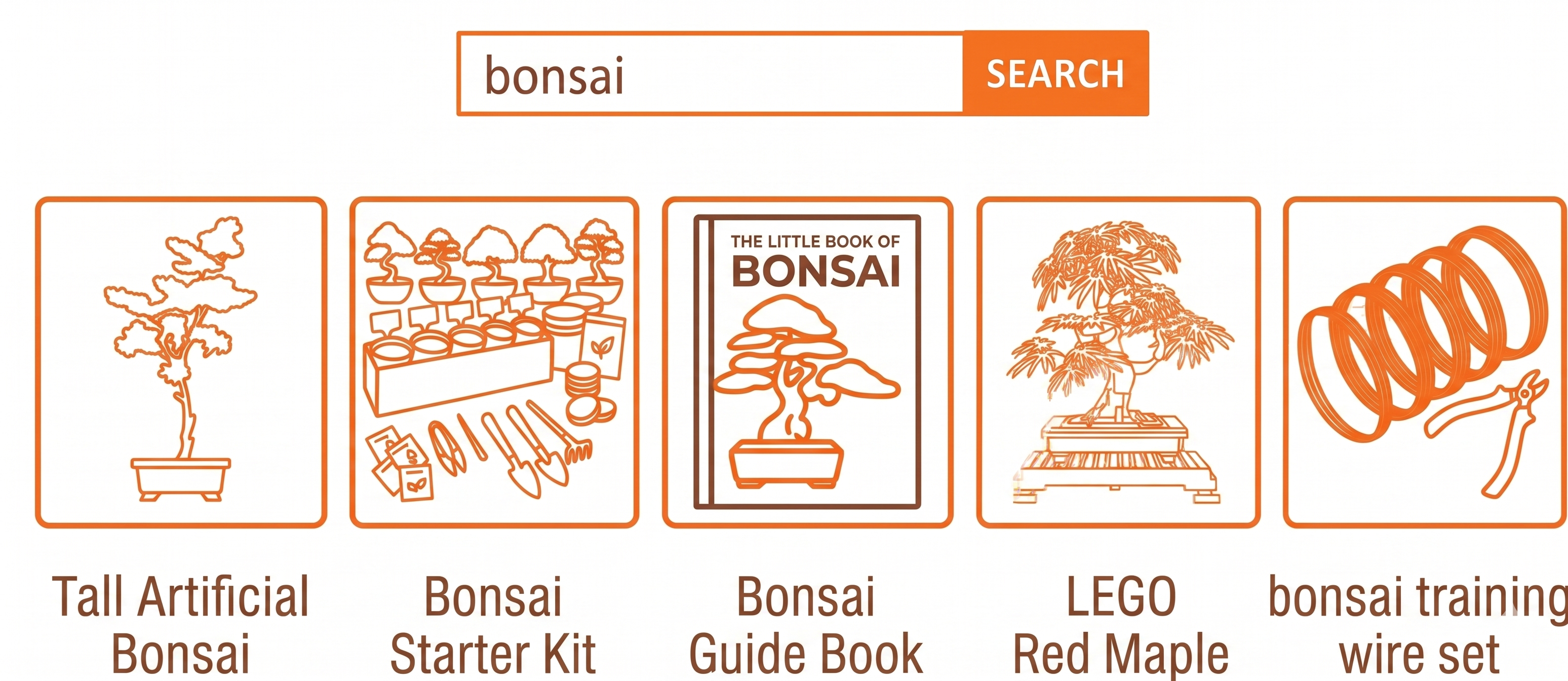
The primary challenge was our scale: Allegro spans 13 distinct departments (Automotive, Home and Garden, Fashion, Supermarket, etc.), each with its own domain-specific nuances, search patterns, and user expectations. Creating a unified set of search relevance annotation criteria that could accommodate everything from a straightforward electronics purchase to a highly ambiguous query in the home decor category was a challenging task. We had to build detailed guidelines that covered a vast range of scenarios — differentiating between simple and vague queries, standard products, and complex product sets.
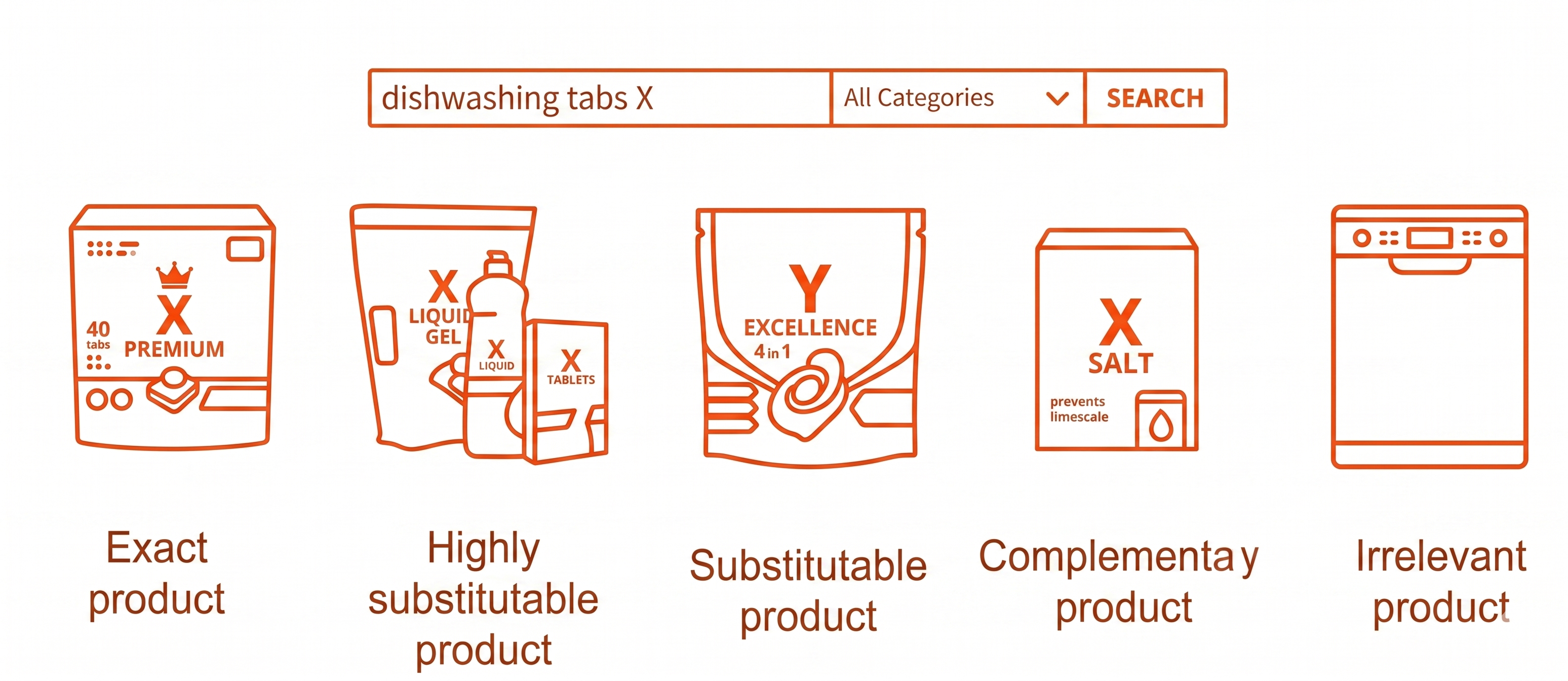
To ensure consistency across multiple annotation tasks, we designed rigorous annotation guidelines covering canonical and borderline cases. Our nomenclature was heavily inspired by the ESCI (Exact, Substitute, Complement, Irrelevant) scale described in this paper, but we aimed for slightly higher granularity to capture the subtleties of our catalog.
Maintaining quality of human annotations required a strict oversight process:
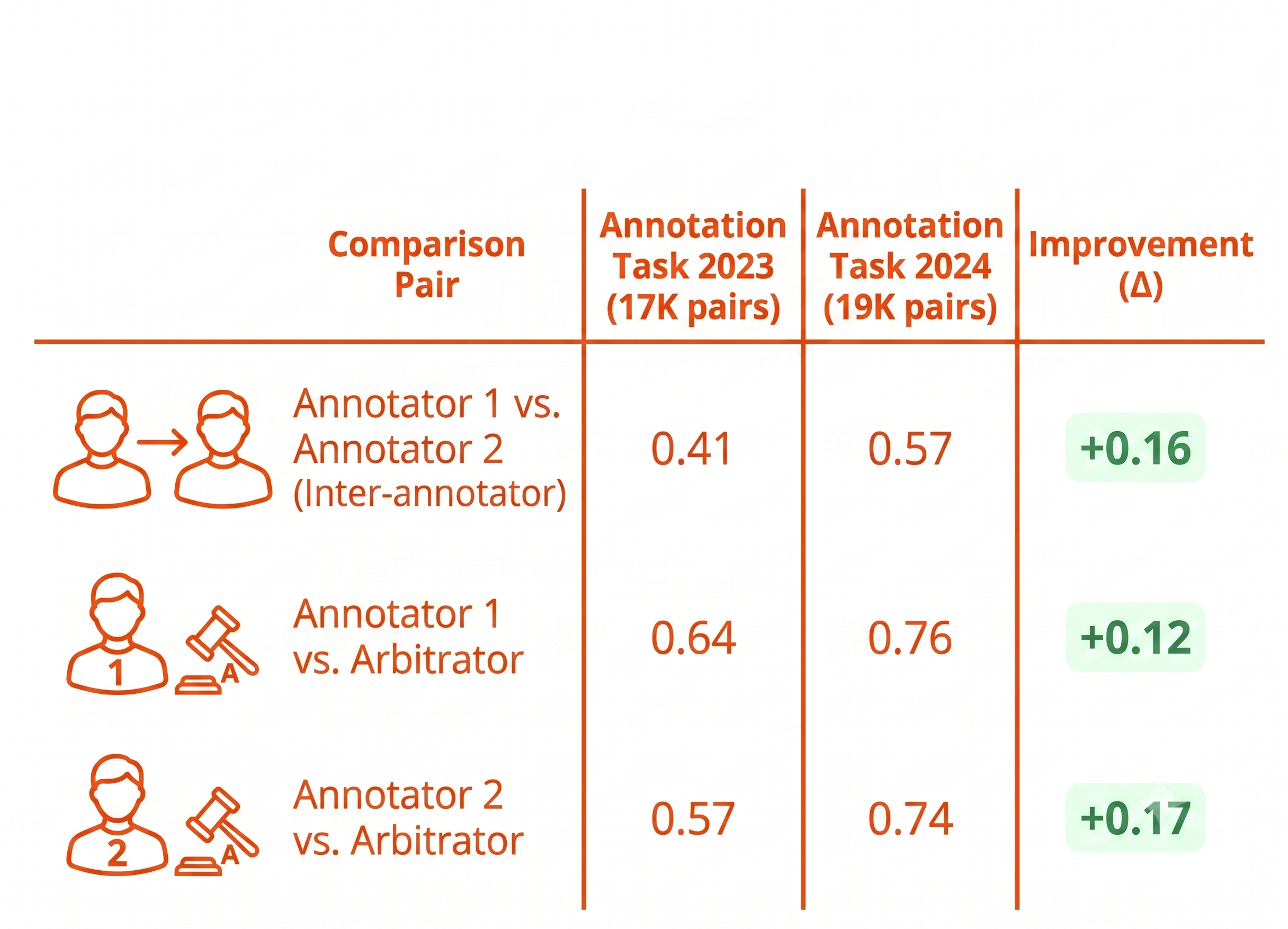
- Expert calibration: We relied on internal search experts to set the standard and collaborated with a team of annotators that consistently annotated all datasets. To maximize precision, for each user search query-product pair we had labels from two blind annotators (independent annotators who label data without knowledge of previous assessments) and an expert arbitrator who solved any label disagreements.
- Continuous alignment: We monitored annotation agreement metrics (e.g. Cohen’s kappa) over time across various tasks. As our team became more aligned on edge cases and consistently followed Allegro’s specific business logic, we saw our consistency improve significantly over time.
The whole process was resource-intensive: we collaborated with approximately 30 experts working on query-product pairs in four languages: Polish (PL), Czech (CZ), Slovak (SK) and Hungarian (HU). The result was a multilingual 380K+ dataset that not only gave us immediate insights into our search quality but eventually provided the essential training and validation data needed to benchmark and refine our move toward the “LLM-as-a-judge” paradigm (to read more about annotation processes at Allegro, see also How to create a synthetic annotator).
LLM-as-a-Judge: prompt design and model selection #
Our transition to “LLM-as-a-Judge” was driven by the need to scale our evaluation while maintaining the precision of human annotation. Thus the prompt for the task was designed directly on the basis of human annotation instructions, ensuring the LLM followed the same business logic and treated edge cases uniformly. These instructions were handwritten by human experts — product and data annotation managers who understand the underlying business logic. We learned that prompt optimization libraries like sammo or gepa can refine such expert-written prompts even further to maximize LLM annotation precision and human-LLM alignment — though they deliver this benefit when building on a solid expert-written prompt rather than generating a strong prompt on their own.
We started with a deliberately simple, text-only approach — the product name is the only input we feed to the model, as it already contains the necessary product information. We also tried adding explicit department and product category information to the prompt, but dropped it because it did not improve output quality in our offline tests — these details can typically be inferred from the product name itself.
The paradox of examples #
Initially, we also experimented with few-shot prompting to guide the model. Surprisingly, our offline experiments (ablations — removing one prompt component at a time) revealed that removing few-shot examples actually improved model performance. The prompt without few-shot examples yielded higher accuracy and agreement scores compared to the few-shot version (for more on metrics used to rate LLM performance see the section below). This suggests that for complex relevance tasks, providing too many examples can introduce noise or bias the model away from the core logic.
The power of reasoning #
The most critical discovery was the value of structured logical constraints. Our benchmarks showed a large performance decline when we removed “critical rules” and “step-by-step” interpretation instructions. In a search relevance assessment task, the model relies heavily on a structured reasoning framework — analyzing intent, interpreting product characteristics, and applying specific heuristics — rather than pattern-matching examples. For example, by embedding our domain-specific business logic directly into the system prompt, we ensure that a compatible third-party mobile phone case is correctly labeled as an “Exact product,” while a third-party printer toner is categorized as “Highly substitutable.”
Model selection and per-class metrics #
We tested various online models, including GPT 4.1 mini, Gemini 2.5 Flash, Gemini 3.1 Flash Lite and Gemini 2.5 Pro. While Gemini Pro consistently delivered the highest performance, Gemini 3.1 Flash Lite proved to be an excellent candidate for production workloads, offering a compelling cost-to-performance ratio. We benchmarked the models using an array of metrics, focusing on model accuracy and agreement scores with human ground truth values. Our analyses revealed that the model is highly reliable at identifying exact matches and complementary items, showing it understands product relationships (e.g. phone cases matching a phone). “Middle-class” relevance remains the most challenging area — the model struggles more to differentiate between “Highly substitutable” and “Substitutable” classes.
| Class | Precision | Recall | F1-Score | Support |
|---|---|---|---|---|
| Exact product | 0.95 | 0.93 | 0.94 | 10413 |
| Highly substitutable product | 0.49 | 0.54 | 0.51 | 607 |
| Substitutable product | 0.32 | 0.34 | 0.33 | 387 |
| Complementary product | 0.87 | 0.80 | 0.83 | 719 |
| Irrelevant product | 0.57 | 0.48 | 0.52 | 480 |
| Hard to say | 0.14 | 1.00 | 0.25 | 43 |
| Weighted Avg | 0.89 | 0.87 | 0.88 |
Table 1: per-class metrics on a selected dataset split for Gemini 3.1 Flash Lite. Precision, recall and F1-score point at “easy” and “difficult” classes. Also, the support values indicate that this dataset split is imbalanced.
Relevance Assessment Tool: a dedicated framework for continuous search evaluation #
To monitor the search quality, we designed an automated evaluation framework that captures Allegro production data and leverages LLMs to conduct regular performance assessments and ensure a comprehensive evaluation of the end-user experience. The system evaluates how effectively the retrieved products fulfill the user intent encoded in the search query, using LLM-as-a-judge evaluation metrics — such as relevance label-based NDCG — to score search results.
The framework serves as a source of quality signals that complement qualitative UX interviews and A/B testing metrics, and it effectively is a core driver for continuous search optimization. It also gathers high-quality training data to enrich and retrain relevance models. Additionally, the tool pinpoints the areas of underperformance and highlights the most challenging query types, allowing engineering teams to focus their efforts efficiently.
Building a dual-speed LLM annotation pipeline: from real-time to batch processing #
Building a reliable LLM-powered system means balancing completely different operational requirements. On the one hand, you need sub-second responses for live, user-facing features; on the other, you need cost-efficient throughput for heavy background analysis. One size definitely does not fit all.
Our system is designed to handle exactly the above challenge. At its core, the application can be split into two categories: on-demand search results annotation and batched model requests for daily search quality verification.
While these two workflows serve different business and product goals, they share the exact same underlying engineering backbone. Whether we are processing a single listing (the ranked page of products returned for a query) in real-time or running thousands of search queries through a nightly cron job, the data follows a strict, predictable path.
To visualize how this works in practice, let’s look at the high-level data flow of our application as shown in this diagram:
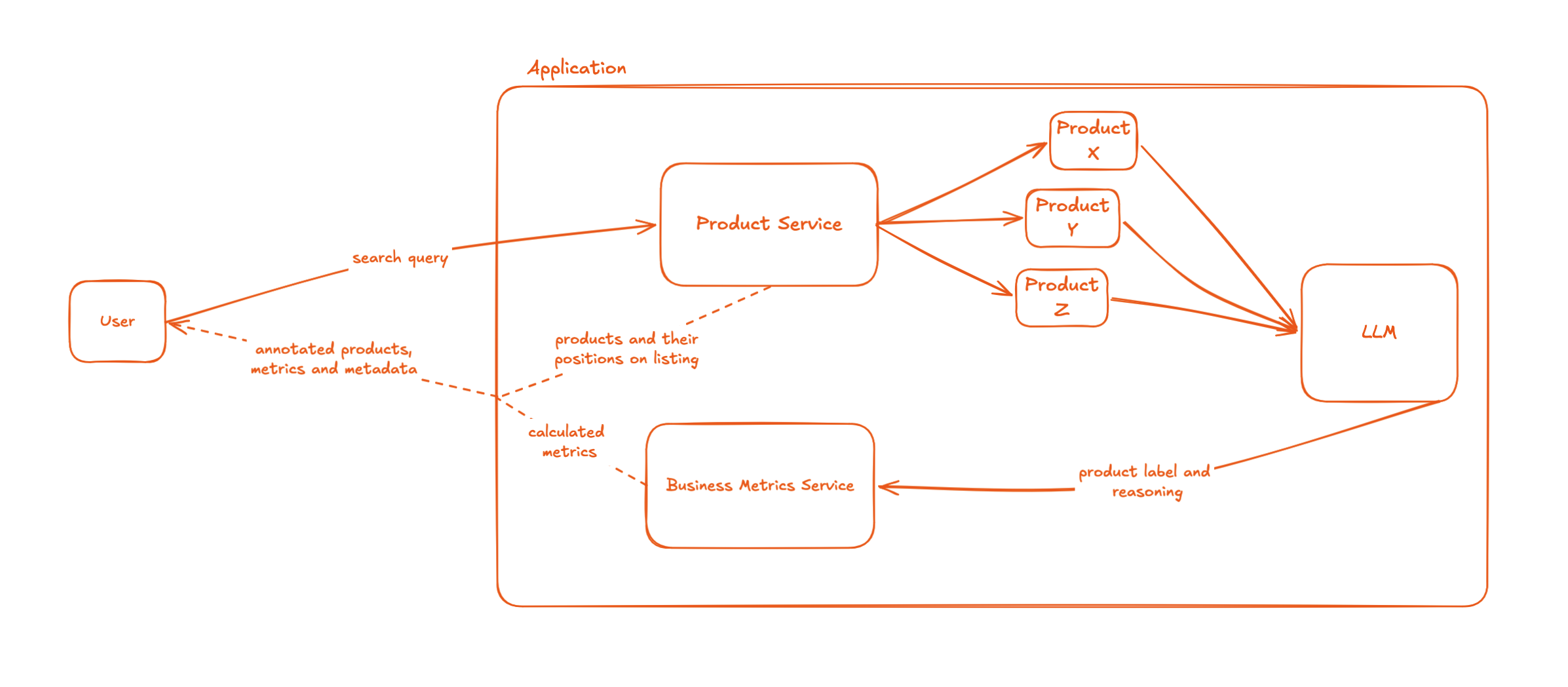
The pipeline highlights the following key processes.
LLM labeling and reasoning #
Following listing fetching, we combine our system prompt with the product details, formatting everything into an OpenAI-compatible structure. The message is constructed like this:
{
  "model": "gemini-3.1-flash-lite",
  "messages": [
    {
      "role": "system",
      "content": "You are an expert search quality evaluator. Analyze the user's search query against the list of retrieved products. [...]"
    },
    {
      "role": "user",
      "content": "Search Query: 'running shoes'\nProducts: [Product X, Product Y]"
    }
  ]
}
A note on batching. Notice that we provide the model with the entire product page (Products A through Z) in a single API request, rather than firing individual requests for each product. Packing the full context into one session reduces network round-trips, optimizes token usage, and cuts costs.
The trade-off: while batching optimizes throughput and latency, single-product requests usually offer higher output precision and quality by preventing context dilution. This matters most for local models, which struggle to return correct answers when a single request contains too many products to annotate. It’s a classic balance between performance and accuracy.
Business metrics calculation #
At this analytical stage, raw LLM classifications are transformed into actionable business insights. To evaluate the true quality of a search listing, it is not enough to just know if a product is relevant — we need to know on which position in search results it appears. In search engineering, a mismatch at position #1 is a critical failure, while a mismatch at position #20 is far less severe. By correlating the LLM’s semantic labels with the exact position of each product on the page, the system calculates core search quality metrics. Ultimately, combining the model’s qualitative reasoning with positional metadata gives us an automated, mathematically sound way to score how well a listing matches the user’s explicit search intent.
Dual-route execution and persistence #
To operationalize this pipeline, a single shared codebase serves two different operational needs. The core logic and transformations remain 100% identical, but the execution vehicle and data persistence layer adapt dynamically:
- For on-demand annotations (real-time): the system executes a direct, asynchronous API call to the LLM. Once the business metrics are calculated, the results are returned to the user.
- For search quality verification (batch): to process thousands of queries without hitting rate limits or blowing the budget, we pivot to asynchronous batch prediction jobs. The final metrics are then dumped using optimized bulk insertions into our analytical data warehouse.
This simple abstraction allows us to reuse our entire prompt engineering and validation pipeline, while maximizing cost efficiency and throughput at scale.
Shifting from cloud to local infrastructure for scale and cost-effectiveness #
Our preliminary “LLM-as-a-judge” framework successfully validated the concept and delivered the precision we needed. However, running large-scale evaluations on cloud-based LLM APIs is expensive, so moving to local models was the natural next step.
Our approach was to benchmark local models against our existing human-labeled multilingual datasets, testing multiple model variants to make sure we wouldn’t compromise the quality established by our cloud baseline (Gemini 3.1 Flash Lite, shown in the last column of the table below). Across all four languages, one model stood out — Gemma 4 26B (AWQ 4-bit, no-thinking) — which for the Polish language exceeded the quality of our Gemini 3.1 Flash Lite baseline. On CZ, SK and HU datasets the cloud baseline retained an edge.
The table below reports the following metrics:
- κ-quad (Cohen’s Kappa quadratic) — agreement with human labels on our ordinal scale, penalizing large rating disagreements much more than near misses (−1 to 1, higher is better). Unlike standard (unweighted) Cohen’s kappa, which treats every disagreement equally, the quadratic weighted variant weights each disagreement by the squared distance between ratings, so mislabeling an Exact product as Irrelevant is penalized far more heavily than confusing two adjacent classes.
- Accuracy — share of exactly correct labels.
- F1 — balanced score that rewards getting all classes right rather than over-predicting the majority class.
- MAE — average distance between the model’s rating and the true rating (0–4, lower is better).
| Language (dataset) | Best local model | κ-quad | Accuracy | F1 | MAE | Cloud baseline κ-quad (Gemini 3.1 Flash Lite) |
|---|---|---|---|---|---|---|
| PL | cyankiwi-gemma (26B, no-thinking) | 0.69 | 0.87 | 0.87 | 0.27 | 0.67 |
| CZ | cyankiwi-gemma (26B, no-thinking) | 0.52 | 0.80 | 0.82 | 0.45 | 0.58 |
| SK | cyankiwi-gemma (26B, no-thinking) | 0.59 | 0.78 | 0.80 | 0.41 | 0.65 |
| HU | cyankiwi-gemma (26B, no-thinking) | 0.67 | 0.83 | 0.83 | 0.35 | 0.73 |
Table 2: comparison of the best local model per language with the baseline cloud-based model (Cohen’s κ quadratic is the primary metric).
Higher κ means better agreement with human ground truth. cyankiwi-gemma (Gemma 4 26B AWQ 4-bit, no-thinking) is the best
local model for Polish. Because the cloud baseline continues to outperform local options for the remaining languages (CZ, SK,
HU), Gemini 3.1 Flash Lite is still suggested as the primary reliable choice.
Along the way, several experiments with local LLMs shaped our final configuration:
- Prompting: adding few-shot examples did not meaningfully improve accuracy for local LLMs, so we kept our baseline prompt.
- The “thinking” model paradox: we compared “thinking” and “no-thinking” model variants and found that “no-thinking” models consistently delivered higher accuracy. This suggests our search relevance assessment task favors direct judgment over multi-step inference chains.
- Product list size: for Gemini models, the prompt includes the whole first page of Allegro’s products to reduce model costs. We tried this approach with local models, to overcome the number of requests and to achieve higher throughput. We tested three ways of passing products to the prompt — the whole product page, 10 products per prompt and 1 product per prompt. The whole-product-page and 10-products-per-prompt variants proved ineffective as most of the model requests failed to parse the response (corrupted JSON, incorrect number of products). We therefore opted for single-item requests to bypass these parsing errors and ensure output reliability.
- Throughput: despite being our largest local model, Gemma 4 26B (no-thinking) was also the fastest in practice, sustaining around 16 query-product pairs per second — roughly 2.5x the throughput of the smaller Gemma 4 12B variant (on the same hardware) — which made wide-scale, continuous evaluation feasible without sacrificing quality.
- Multilingual performance: our evaluation spanned four languages (PL, CZ, SK, HU). Polish served as our primary benchmark thanks to the largest volume of labeled data. Among the other languages, Hungarian performed especially well, while Czech proved the hardest for every model. Notably, online models retain an edge on other languages — Gemini 3.1 Flash Lite outperformed our best local model on Slovak and Hungarian, making it the more reliable choice for those languages.
The transition to the local models came with engineering challenges. We hit periodic parsing errors when models struggled with strict output formatting, which we mitigated through robust schema enforcement and refined post-processing so outputs could be cleanly ingested into our pipelines. Models that couldn’t meet this reliability bar (e.g. Mellum 2 12B AWQ — parse errors, or PLLuM 8B — class-imbalance exploitation) were ruled out regardless of high accuracy (see the table below).
| Model | Type | κ-quad | Accuracy | Throughput | Notes |
|---|---|---|---|---|---|
| cyankiwi-gemma (26B, no-thinking) | local | 0.69 | 0.87 | ~16 it/s | Best local model — matches cloud quality |
| Qwen 3.6 27B (no-thinking) | local | 0.70 | 0.86 | n/a | High κ but ~5% parse errors — unreliable |
| Gemini 3.1 Flash Lite (single) | cloud | 0.69 | 0.87 | n/a | Cloud baseline |
| Gemma 4 qat 12B (no-thinking) | local | 0.68 | 0.86 | ~5–7 it/s | Solid, but weaker on languages other than PL |
| Gemma 4 26B AWQ (thinking) | local | 0.65 | 0.86 | ~16 it/s | 2nd place — thinking variant underperforms |
| Gemma 4 4B | local | 0.56 | 0.86 | n/a | Smaller model, lower agreement |
| GPT-OSS 20B | local | 0.64 | 0.88 | n/a | 5% parse errors |
| Bielik minitron 7B | local | 0.53 | 0.83 | n/a | 0.6% parse errors, clearly below Gemma |
| PLLuM 8B | local | 0.17 | 0.84 | n/a | Exploits class imbalance — unusable |
| Mellum 2 12B AWQ | local | 0.17 | 0.76 | n/a | 20% parse errors — unusable |
Table 3: model comparison on the primary benchmark (PL). Accuracy is the raw share of correct labels and can be misleading on its own when classes are imbalanced (see PLLuM metrics).
| Factor | Finding |
|---|---|
| Thinking vs no-thinking | No-thinking consistently wins (e.g. Gemma 4 26B: κ-quad 0.69 vs 0.65 on PL) |
| Few-shot prompting | No meaningful gain over the baseline prompt — kept baseline |
| Product list size | Severe penalty: Gemma 4 4B drops from κ-quad 0.56 (single) to 0.34–0.37 (batch of 10) |
| Throughput | cyankiwi-gemma reaches ~16 items/s (batch 512) vs ~5–7 items/s for 12B |
| Parse errors | cyankiwi-gemma stays <0.2% across all languages; PLLuM/Mellum/GPT-OSS unreliable |
Table 4: model configuration findings.
The result: by deploying the best-performing local model, we matched the quality of our cloud baseline while cutting inference costs by roughly 60%. This lets us run continuous, wide-scale relevance assessment — without the linear per-call cost scaling that cloud APIs demand.
Future directions #
Our journey with the Relevance Assessment Tool is far from complete. While we have achieved a significant milestone in automating evaluation at scale, a primary area of development is the transition toward multimodal inputs. Currently, our system relies on textual data, which provides a strong baseline, but we see significant potential in incorporating product images. By enabling the model to “see” the products, we aim to improve relevance accuracy for departments like fashion and home design, where visual cues are often as crucial as textual descriptions for inspirational searches (e.g. boho dress, industrial home decor).
Beyond visual integration, we are also moving toward a more granular understanding of both search queries and product specifications. Obviously, this requires the constant development of LLM-as-a-Judge evaluators and is based upon data assets containing manual annotations of gold ground-truth datasets, which must cover growing business complexity (different departments, diverse user needs, and personalization strategies). Finally, we remain committed to refining our continuous benchmarking pipelines to be even more robust, ensuring we maintain high-performance standards across our entire multilingual catalog as we continue to grow.
Model links #
- Gemma 4 12B
- Gemma 4 E4B
- Gemma 4 E2B
- Qwen 3.6 27B (AWQ INT4)
- cyankiwi-gemma (Gemma 4 26B AWQ 4-bit)
- Bielik Minitron 7B
- GPT-OSS 20B
- PLLuM 8B
- Qwen 3.5 9B
- Mellum 2 12B (AWQ INT4)
- Gemma 4 12B (QAT q4_0)
Credits #
The present article is the result of collaboration of the Narwal (Search relevance) and Data Annotation & QA Services (DAQAS) teams. We extend our sincere thanks to the Pytia (Search Analytics), LTR (Learning to Rank) and Phi (Search user guidance) teams for their invaluable contributions to accuracy metrics, RAT development and UX design.