
If your test cases are scattered across multiple Excel files, Google Docs, and Confluence pages, and keeping them up to date is incredibly time-consuming, this post is for you. This is the story of how Allegro moved from scattered, manual test tracking to a scalable, Jira-based solution now available to thousands of engineers.
The state of affairs, or: How many excel files can you juggle? #
Let’s paint a picture. You join a new team operating in a complex, distributed architecture. You want to understand the high-level business flows and cross-team end-to-end scenarios, so you ask: “Where are the E2E test cases?” Your colleague takes a deep breath. “Well,” they say, “some are in Confluence. Some are in a Google Doc from 2021 that Harper made before he left. There’s also a spreadsheet, but I think Charlie updated it locally and never pushed it. And then there are the acceptance criteria in the Jira tickets, if you squint hard enough.”
This is not a hypothetical. This is — or rather, was — a fairly accurate description of test management at scale in a company with hundreds of development teams. The official term for what we had is “distributed knowledge.” The unofficial term involves more colorful language.
The symptoms were familiar to anyone who has worked in a large-scale software organization:
- Scattered data: test cases spread across Excel, Word, Google Docs, Confluence, Jira descriptions, and the occasional sticky note.
- No single source of truth: trying to understand the overall testing state felt like assembling IKEA furniture without instructions — theoretically possible, practically maddening.
- Process inconsistency: every team had their own methodology, their own tool, their own naming convention. Communication across teams resembled a game of telephone.
- Knowledge gaps: onboarding a new team member? Enjoy your archaeological expedition through 18 months of chat history.
- Duplicate efforts: three different teams, independently, at approximately the same time, writing nearly identical test cases for the checkout flow. A distributed systems problem in the most ironic possible sense.
- Lack of formalized test scenarios: in some cases, regression or manual testing relied entirely on the team’s domain expertise rather than predefined, repeatable test procedures. While experienced engineers knew exactly where to look, the lack of documented test cases made these validation processes non-transferable and hard to scale.
The main challenge was structural rather than technical. Unit and integration tests for individual services lived safely in repositories, but end-to-end testing of broader business flows required coordination across teams and a shared place for documenting and maintaining those scenarios. At the time, we did not yet have a standardized, centralized tool that fit naturally into how our engineers already work. As a result, many teams relied on the tools that were most readily available to them, and over time that led to a landscape of spreadsheets and documents distributed across the organization.
The quest begins: in search of the holy plugin #
Once the problem was clearly articulated — which itself took some effort — the natural question arose: what should we do about it? We knew we needed a test management tool. We had some idea of what “good” looked like. And we had one very firm constraint: it needed to integrate deeply with Jira, since that’s where our teams already live, breathe, and track their work.
The existing solution in our software catalog was TestRail — a well-known, capable, and very much external tool. The problems with TestRail were threefold. First, it lives outside Jira, which means context-switching and integration overhead. Second, licensing it for an organization of our size would require the kind of budget conversation that nobody enjoys having. Third, and perhaps most pragmatic one: limited licenses meant only select people could use it, which made it much harder to share test cases across the organization and manage them effectively at scale. That defeated the purpose of a company-wide quality culture.
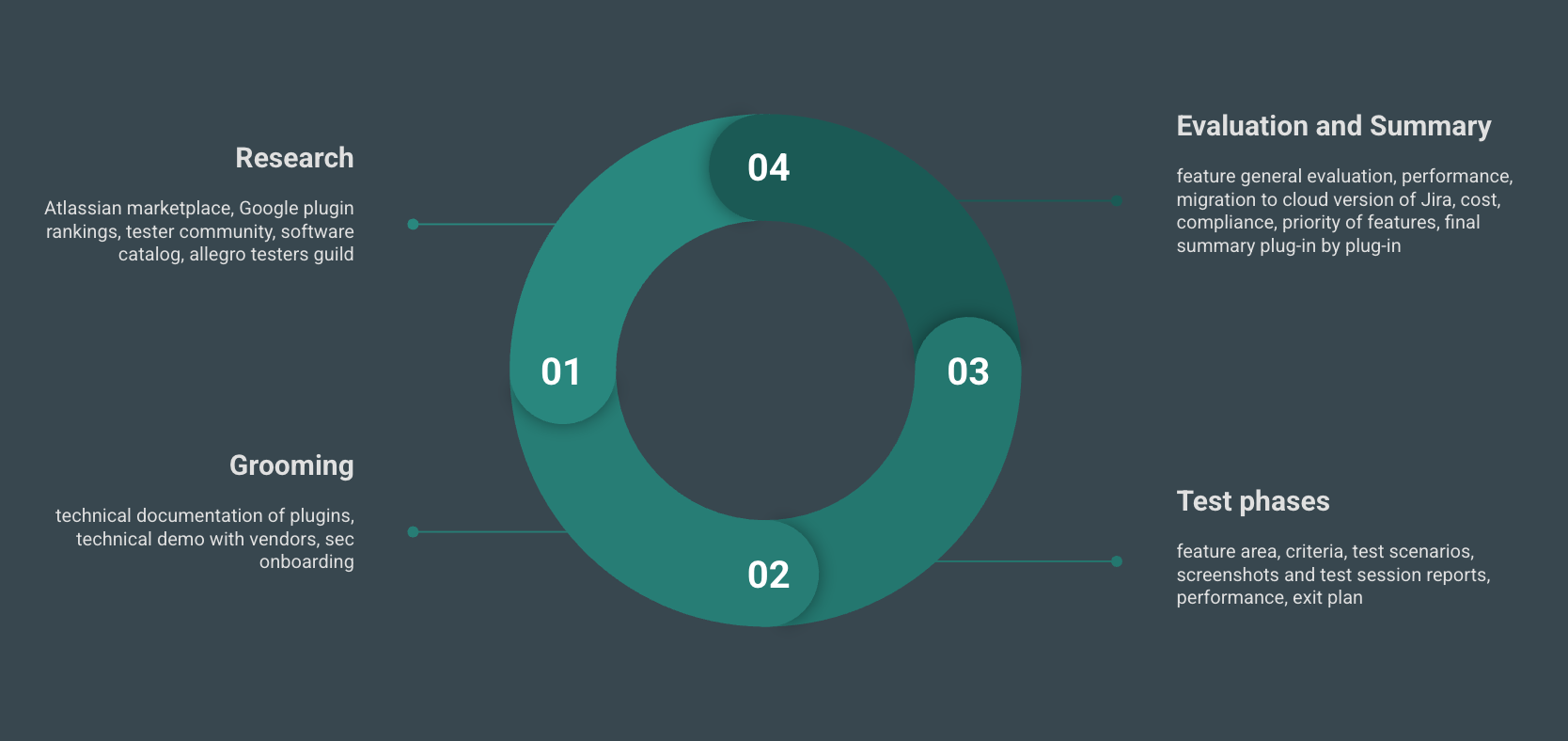
So we embarked on a proper market analysis. We identified the key functional requirements, compiled a list of candidate tools, narrowed them down to three finalists, and ran them through a structured testing phase in a dedicated Jira test environment. Each tool was evaluated across a comprehensive set of criteria: test design, import/export capabilities, test execution lifecycle, requirements traceability, automation framework integration, CI/CD pipeline support, Jira integration quality, reporting, and dashboards.
We even made demo videos for each category. Twelve categories, multiple tools. This was, to put it diplomatically, a significant investment of time and effort.
The great plugin bake-off #
Three tools entered the ring. After rigorous evaluation, one emerged victorious: QMetry Test Management for Jira (QMetry), developed by SmartBear Software.
Why QMetry? A few reasons that genuinely mattered in our context:
It lives inside Jira. This is not a small thing. When test cases, requirements, defects, and user stories all exist in the same tool that your developers, product managers, and business analysts already use, the collaboration overhead drops dramatically. No context switching, no manual synchronization between systems, no “oh, that’s in the other tool.”
Traceability without tears. QMetry allows you to link test cases directly to Jira user stories and defects, track execution history, and generate real-time dashboards. Stakeholders can see test execution progress without having to ask anyone. (This last point was received with particular enthusiasm by product managers, for reasons that will be obvious to anyone who has ever been asked “so how’s the testing going?” for the fourteenth time.)
Automation-friendly. We use Cypress, Playwright, and RestAssured, among others. QMetry supports automatic test result uploads from these frameworks and can be wired into CI/CD pipelines — so the test management tool becomes a natural part of the delivery flow rather than a post-hoc reporting exercise.
Scale. Our organization has hundreds of teams, international markets, and a growing need for cross-team test coordination. A plugin that runs inside our existing Jira infrastructure inherits that infrastructure’s scalability properties. We are not adding another system to maintain; we are extending the one we already have.
Rolling it out at scale #
Deploying any new tool to a large engineering organization is less of a technical challenge and more of a change management challenge wearing a technical disguise. You can have the best tool in the world and still fail spectacularly if you ignore the human factors: adoption, training, incentives, and the deeply ingrained habit of opening Excel by default.
Our approach was to start with teams that had the clearest and most immediate need — those dealing with internationalization testing, accessibility, and large cross-team projects. Early adopters help establish patterns, expose edge cases, and produce the kind of concrete success stories that make later adoption feel less risky for skeptics.
We also invested in making the “right way” the easy way. Integration with our existing automation frameworks means that teams already doing test automation can get their results into QMetry without heroic effort. CI/CD integration means the feedback loop is short and automated. The goal is a world where using QMetry is simply the path of least resistance — not a missionary project requiring continuous persuasion.
How will we know if it worked? #
The rollout is already live in production, and the plugin is available to 100% of Jira users across our projects. The next step is to track how teams adopt it in practice and whether it improves the quality and visibility of their testing processes over time.
For this type of project, a practical measurement framework could include:
- Adoption: number of projects with the plugin actively in use, number of active users, growth rate of created test procedures and test case repositories.
- Quality signal: number of defects linked to specific test cases and issue types, volume of generated reports, frequency of test suite updates.
- User satisfaction: periodic ratings on a 1–5 scale, qualitative feedback on the most valuable features, and the always-illuminating question: “Would you keep using this next year?”
- Operational usage: number of executed test runs, share of test executions triggered through CI/CD, and frequency of automated result uploads from integrated frameworks.
- Process maturity: percentage of test cases linked to requirements or defects, share of projects with documented regression suites, and reuse of shared test scenarios across teams.
- Enablement reach: training attendance, tutorial completion, webinar participation, and the number of teams that move from evaluation to regular day-to-day use.
Together, these indicators help assess whether the rollout is gaining adoption, improving traceability and execution discipline, and delivering practical value across teams over time.
What we have learned (so far) #
A few things that may be useful to others attempting something similar:
Define your requirements before you look at tools. It sounds obvious. It is apparently not obvious. Starting with a clear list of “must have” and “nice to have” capabilities — and getting stakeholders to agree on that list before demoing anything — saved us a significant amount of time and debate later in the process.
The Jira-native constraint mattered enormously. For organizations deeply committed to Jira as their project management backbone, the friction of an external tool is real and should not be underestimated. A plugin that lives inside your existing environment inherits trust, familiarity, and access controls you would otherwise have to recreate.
Testing debt is real and it compounds. Every new market, every new product area, every new team that onboards without a structured test management process adds to a growing deficit. The later you address it, the more expensive it becomes — not just financially, but in terms of institutional knowledge, consistency, and the sheer volume of tests that will eventually need to be migrated or recreated.
Change management is the hard part. The plugin selection was the fun part. The tool evaluation was intellectually satisfying. Getting hundreds of teams to change their established workflows is where the real work begins. Patience, clear communication, and visible wins from early adopters are your most important tools — not the plugin itself.
Retrospective: Driving change from the bottom up #
Looking back at the entire journey, a project like this succeeds or fails based on how well you engage the community. In our case, it was a truly bottom-up initiative led by the testing community. It started with one person who pulled together a small tester task force, and that core group drove the work end to end. To avoid optimizing for only one domain, we validated decisions continuously with the broader QA community: collecting volunteers, running feedback loops, and gathering test needs from different areas before locking major rollout choices. We also ran regular synchronization with different business domains and key stakeholders to keep priorities aligned and incorporate cross-functional needs.
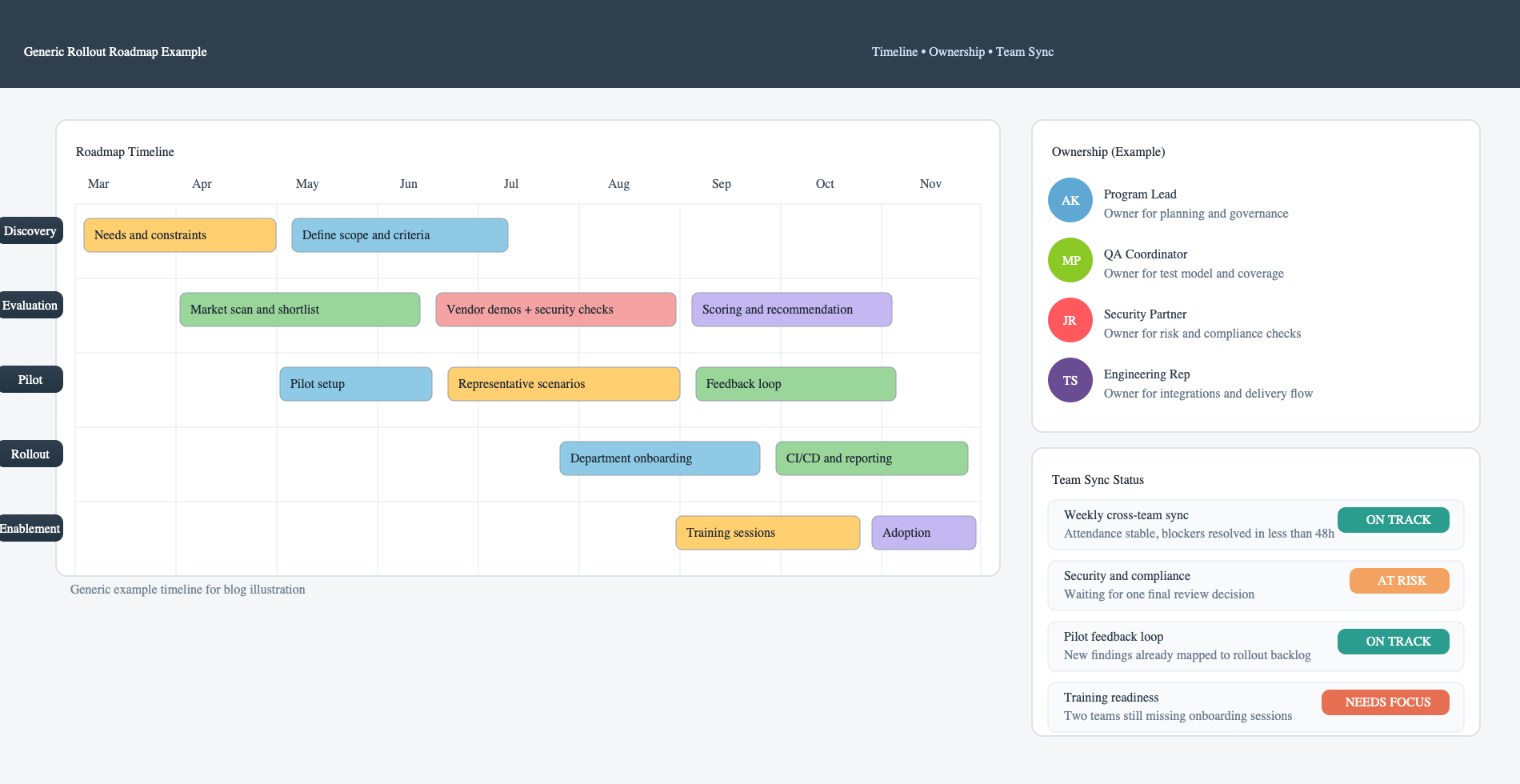 This infographic was prepared with the assistance of AI; its content has been reviewed by the author.
- Start with the testing community. Collect opinions early, discuss pain points, and translate feedback into explicit requirements.
- Build your coalition. Find “partners in crime” and business stakeholders who will actively support the rollout and explain its value in business terms.
- Structure decision-making. Use comprehensive Request for Proposal (RFP) documents, compare options transparently, and synchronize work across teams.
- Build a diverse quality team. Include people with different seniority levels and perspectives, and involve the security department for technical support.
- Keep progress visible. Use mind maps, roadmaps, and regular status updates so teams can see where the project is and what comes next.
- Invest in adoption at the end. Record tutorials, run training sessions, webinars, and presentations. In short, you need to “sell” the product internally to make adoption sustainable.
To make this practical, use an RFP template with a feature scoring matrix, a repeatable test phase flow, and one critical rule for coordination — always keep a single reference link (single source of truth) for criteria, scores, and final decisions.
In practice, tie each test scenario directly to a specific feature area, as shown in the template. A practical mapping can look like this:
- Design and test case management -> create/edit/version test case, folder structure readability, and custom fields behavior.
- Import and export -> cross-project export/import, re-import updates, and field mapping consistency.
- Execution and environments -> test execution creation, environment setup, history tracking, and exploratory runs.
- Traceability -> linking requirements, test cases, and defects, then validating traceability reports.
- Automation and CI/CD integration -> ingest automated results, attach artifacts, and verify pipeline/notification flow.
- Reporting and PM visibility -> dashboards, filters, and progress tracking for stakeholder updates.
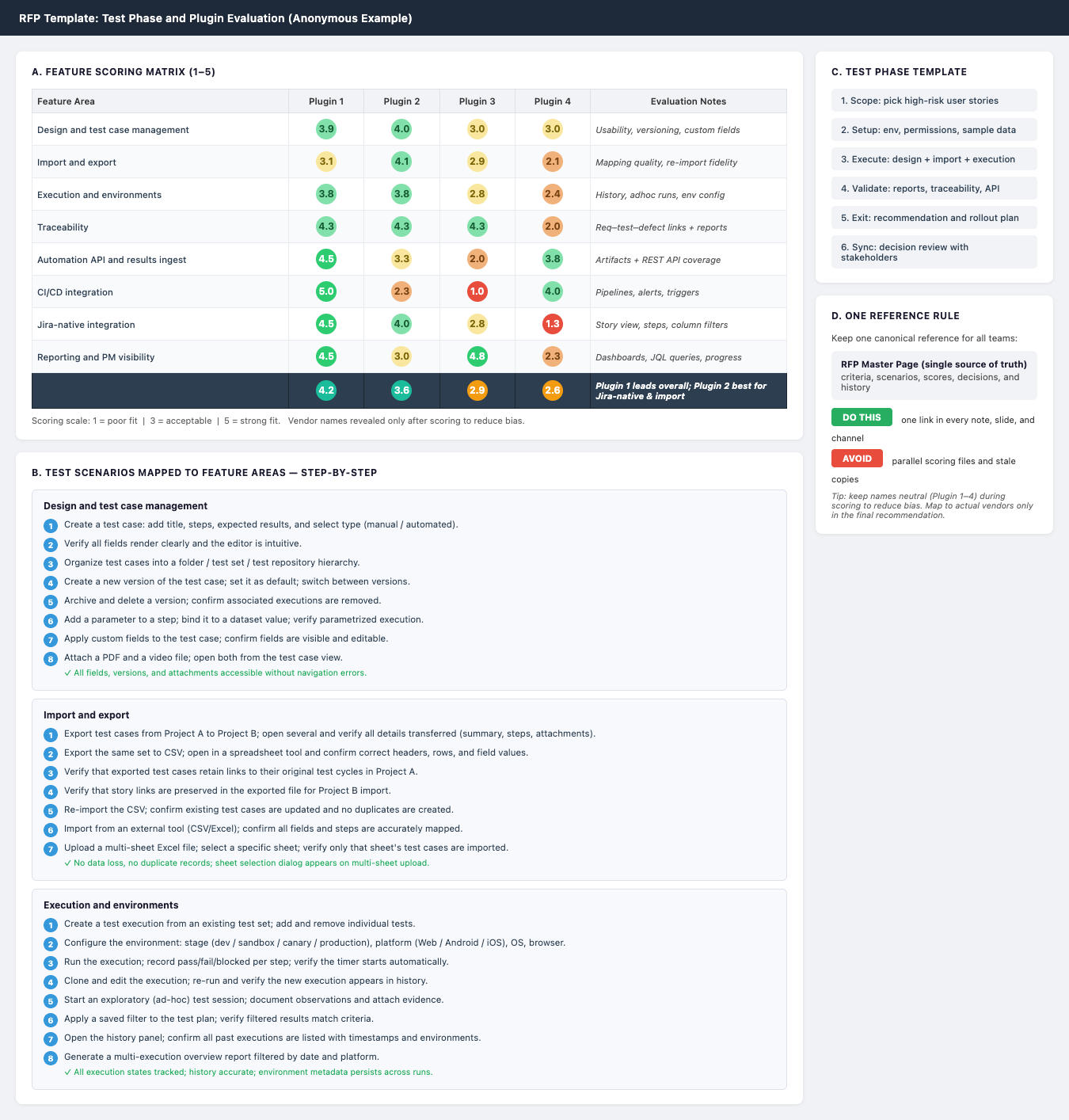 This infographic was prepared with the assistance of AI; its content has been reviewed by the author.
Before we wrap up: seven myths worth challenging #
Test management tools can dramatically improve visibility and coordination, but they are not magic wands. During the rollout, we kept hearing the same myths:
- “Only testers can use it.” Value grows when developers, analysts, and product stakeholders use shared test artifacts.
- “The tool guarantees better testing.” The tool supports process quality; it does not replace engineering discipline.
- “It will automatically reduce defects.” Defect trends improve only when teams consistently act on insights from execution data.
- “Now we can track everything.” Tracking still requires clear ownership, scope, and governance.
- “Communication is no longer needed.” Shared tooling reduces friction, but cross-team conversations remain essential.
- “Reports will interpret themselves.” Dashboards provide signal, but people still need to analyze, prioritize, and decide.
- “The day we install the plugin, Excel chaos will disappear overnight.” Real change takes time: local champions, tailored onboarding, and visible wins in each team.
We are still early in this journey. The rollout continues, the adoption metrics are being watched, and somewhere, inevitably, someone is still opening Excel out of habit. But the direction is set, the tool is deployed, and the era of “testing by gut feeling” is — slowly, measurably — coming to an end.
If you have questions, lessons of your own to share, or just want to commiserate about test management in large organizations, feel free to reach out.